
How to Choose an Asset Allocation You Can Actually Stick With

Most passive, long-term investors split their portfolio between two main asset classes:
Stocks (equities), which have higher expected growth and inflation protection in the long term, but at the cost of significant volatility and drawdowns in the short term. The primary goal of owning stocks is capital appreciation.
Bonds (fixed Income), which have significantly lower expected volatility and drawdowns in the short term, but at the expense of lower returns in the long term. The primary goal of owning bonds is capital preservation.
The decision of how to split your portfolio between stocks and bonds is called asset allocation. For example, a portfolio of 60% stocks and 40% bonds would have a 60/40 allocation. Allocations with more stocks generally have higher growth potential (greater expected returns over time), while allocations with more bonds generally have stronger drawdown protection (smaller expected dips over time):

As alluded to in the graphic, the asset allocation you select will ultimately determine the magnitude of the returns your portfolio will deliver in the long term, and the severity of the drawdowns your portfolio will experience along the way.
Why is asset allocation so important?
Determining the right asset allocation for your situation is likely the most important investment decision you will make. Research has shown that over 90% of a portfolio's return and volatility is driven by broad asset allocation, not by timing the market or picking the right stocks.
Unfortunately, selecting the right allocation can feel daunting! If you’re too conservative with your allocation, your money might not grow as much as you need it to over time. On the other hand, if you’re too aggressive, you might panic when your portfolio shrinks in the next market downturn. The biggest risk to your long-term portfolio is choosing an allocation you can’t stick with during a crash, leading you to panic-sell at market lows and turn temporary paper losses into permanent unrecoverable losses.
(Note: Planned withdrawals from your portfolio can also have the same destructive effect in market downturns, and need to be allocated for differently - see the caveat section below.)
How do I select the right allocation for me?
To recommend an asset allocation, financial advisors will often ask their clients a series of questions about their risk tolerance (their psychological willingness to take risk) and risk capacity (their financial ability to take risk), and then qualitatively map their responses to a more conservative or aggressive asset allocation.
Unfortunately, these types of assessments can feel very abstract and hypothetical to the investor, and often fail to answer more quantitative questions, such as:
How much higher a return can I expect from a 90/10 allocation than a 60/40 allocation?
What size of drawdown might I experience with a 80/20 allocation as compared to a 50/50 allocation?
How much larger will my portfolio be in the long run if I shoot for an 8% return vs a 6% return?
The goal of the data below is to help you gain a quantitative intuition for the risks and returns associated with a given asset allocation, so you can choose an allocation that’s right for you.
First, some caveats
This article is focused solely on long-term asset allocation, for money you do not anticipate spending for a decade or more. It is ill-suited to determine the right allocation for:
Known expenses in the next 5-10 years: Allocating assets for anticipated near-term expenses should be determined separately. This article walks through the decisions and tradeoffs needed to properly allocate assets that are earmarked for near-term expenses.
Generating retirement income: For investors nearing or in retirement, the need to take regular withdrawals from your retirement portfolio changes asset allocation significantly. This article discusses some ways to think about asset allocation as you approach or enter retirement.
The allocation information below applies only to the long-term portion of your portfolio - money you don’t plan to touch for at least 10 years.
Step 1: Understand how market returns attenuate over time
To make an informed decision about asset allocation, it’s important to understand how the risk and returns of the stock market play out over time. While the stock market can feel like a roller coaster from month to month, its returns become much less volatile and much more predictable over time.
One way to get an intuitive sense of this is to look at the range of returns (the best and worst returns) for various allocations over time. The chart below shows the range of historical returns from the last 75 years for various asset allocations (100% stocks, 100% bonds, 60/40) over various holding periods (1yr, 5 yrs, 10yrs, 20yrs):
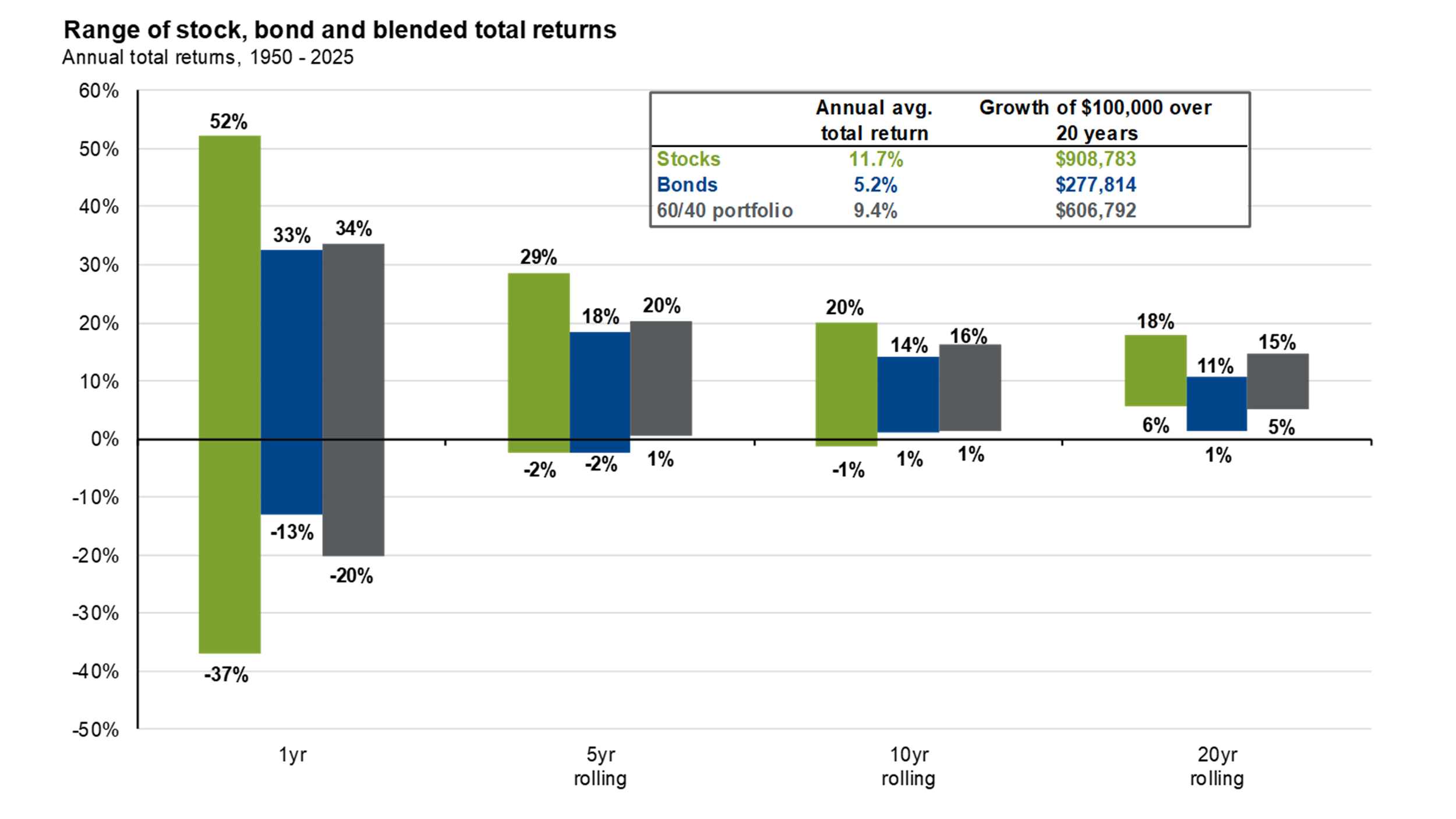
The key thing to note is that, while stocks have had annual returns ranging from 52% at the high end down to -37% at the low end (gulp!), those wild fluctuations attenuate significantly as holding period increases, with the lowest annualized return for any five year holding period being -2%, and the lowest returns for any 20 yr holding period being a positive 6%.
This fundamental behavior of the markets underlines the importance of maintaining a long-term perspective on your portfolio returns. Investing for the long term will not shield you from experiencing the wild swings of the market from year to year, but it should reassure you that, as long as you don’t panic-sell when the markets are down, you should be able to harvest the sizable returns that the markets have historically delivered to those who are patient.
One of the most common ways investors fail to invest for the long term is by underestimating their holding period, assuming they will need the money much sooner than they will actually access it. This leads them to be more conservative with their allocation than their actual time horizon would call for, severely hampering their portfolio’s ability to deliver sizable returns in the long run.
Step 2: Understand the drawdowns you might experience at various allocations
In order to know if a particular allocation is too risky for you, it's important to get a sense of the potential drawdowns you might experience at that allocation. The chart below illustrates the greatest calendar-year gains and losses over the last 100 years across the full range of stock/bond allocations:
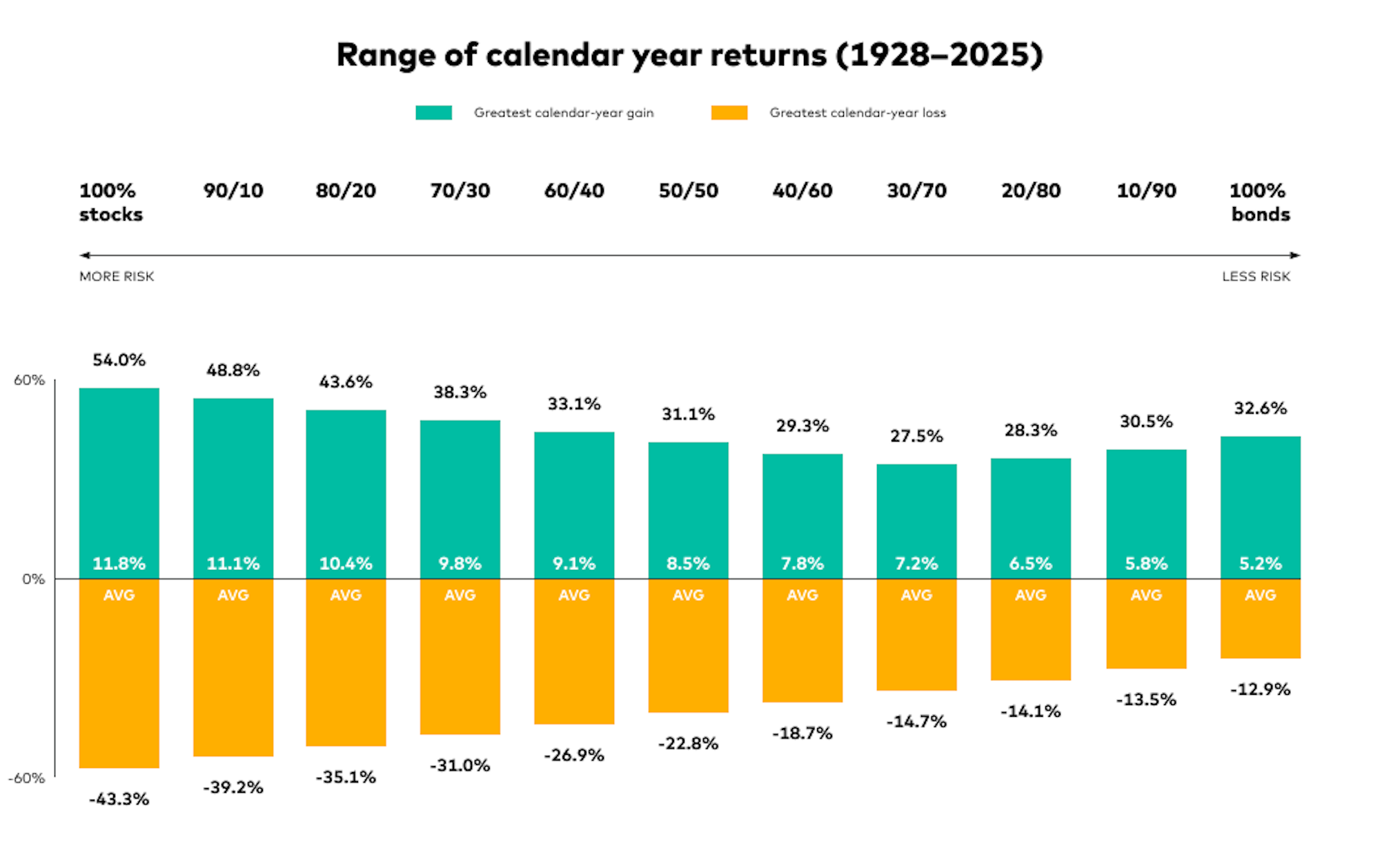
Note that, as the percent of bonds in the portfolio increases, the greatest calendar-year drawdown decreases. For example, a 100% stock portfolio experienced a loss of -43.3% at some point during the past 100 years, whereas the traditional 60/40 portfolio only saw a drawdown of -26.9%. For a $1M portfolio, that difference is significant: it means the 60/40 portfolio ended the year at $731k while the 100% stock portfolio ended the year at $567k, a difference of $164k!
This difference in the severity of drawdowns underlines the importance of picking an allocation you can stick with over time. If you can’t stomach a 40% or greater drop in your portfolio and decide to sell when the markets are down, you lock in your losses and permanently stunt your portfolio’s ability to recover and deliver the long-term returns discussed in the prior section. In that case, you would be better off selecting a more conservative allocation with less exposure to stocks, and therefore less stomach-churning volatility from year to year.
Step 3: Understand the potential returns of higher stock allocations
While the prior chart illustrates the drawdowns we need to be prepared to endure at various allocations, it’s important to balance them with an understanding of the potential returns of higher stock allocations. Otherwise, we might select an allocation that feels safe, but is in fact too conservative, unable to deliver the long-term portfolio growth we need to outpace inflation and achieve our financial goals.
Extracting the average annual returns for each allocation shown in the Vanguard chart from the prior section, we can calculate the growth we might expect a portfolio to achieve at each allocation. The chart below illustrates the growth of $100k over 20 years, translating those average growth rates into actual dollar amounts over time:
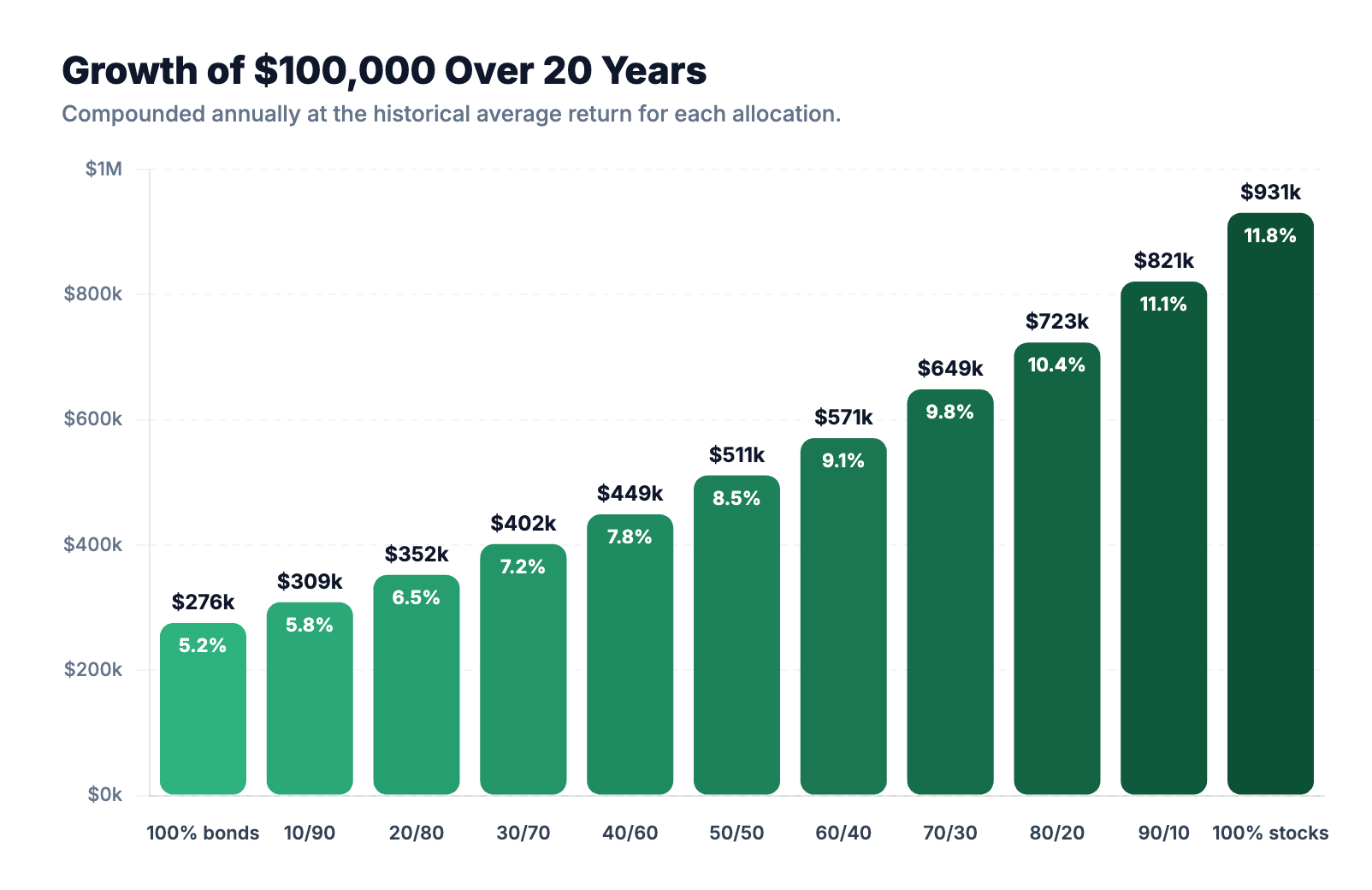
While these are historical growth rates and there is no guarantee that a particular allocation will deliver its historical return in the future, they can provide a sense of the relative returns each asset class has the potential to generate in the long run.
The key thing to note is that, over time and with compounding, seemingly slight differences in the rates of return between allocations result in significant differences in actual portfolio value. For example, a 60/40 portfolio has historically returned 9.1% annually, while a 90/10 portfolio has returned 11.1%, a difference of only two percentage points. But after 20 years of growth, that 2% difference generates a potential $250k in additional returns, or 44% more wealth.
How can I be sure I’ve chosen the right allocation?
While it can feel daunting to try to balance hypothetical drawdowns against potential returns, it may be helpful to remember that selecting an allocation is not an exact science. None of the historical drawdowns or returns are guaranteed to persist in the future, and there are just too many variables to know exactly how your portfolio will perform over time.
Instead of trying to find the “perfect” allocation, your goal should simply be to make sure you’re not way off the mark. This means finding an allocation that is likely to deliver significant long-term returns without exposing you to drawdowns you are unable to tolerate.
For most clients who are far away from retirement (10+ years), a 100% equities allocation is often the most sensible choice: their portfolio will likely have plenty of time to recover from even a severe market crash. However, for clients whose risk tolerance is lower and who would struggle enduring wild swings in their portfolio balance, some amount of bonds could help mute that volatility and prevent destructive panic-selling.
For example, if you think you are likely to panic and lose sleep if your portfolio drops by 30%, you should probably avoid allocations above 70/30. On the other hand, you should select the highest allocation you think you can possibly stomach, so that your portfolio has the potential to deliver meaningful returns over time.
For most clients, a long-term portfolio allocation below 60/40 is generally not recommended, as the smoother ride requires sacrificing significant returns in the long run. Note that even a 50/50 or 40/60 allocation can still experience drawdowns of 20+%, so some tolerance for volatility is still required even for very conservative portfolios. In other words, some amount of risk is unavoidable if you want to have any chance of outpacing inflation.
Finally, know that you can change your allocation at any time. While you want to avoid shifting your allocation around with every new headline, it may be helpful to reconsider your allocation every few years to make sure it aligns with your current situation and goals. The main goal of whatever allocation you choose is peace of mind - to feel assured that your assets are positioned to weather whatever storms may come and produce the returns you need in the long term.
